
Concrete Costs 2026: Tariffs, Shortages & Budget Guide
Concrete costs have risen 3–7% from 2025. This guide breaks down how tariffs, cement shortages, and infrastructure spending are affecting prices — and how to protect your budget.
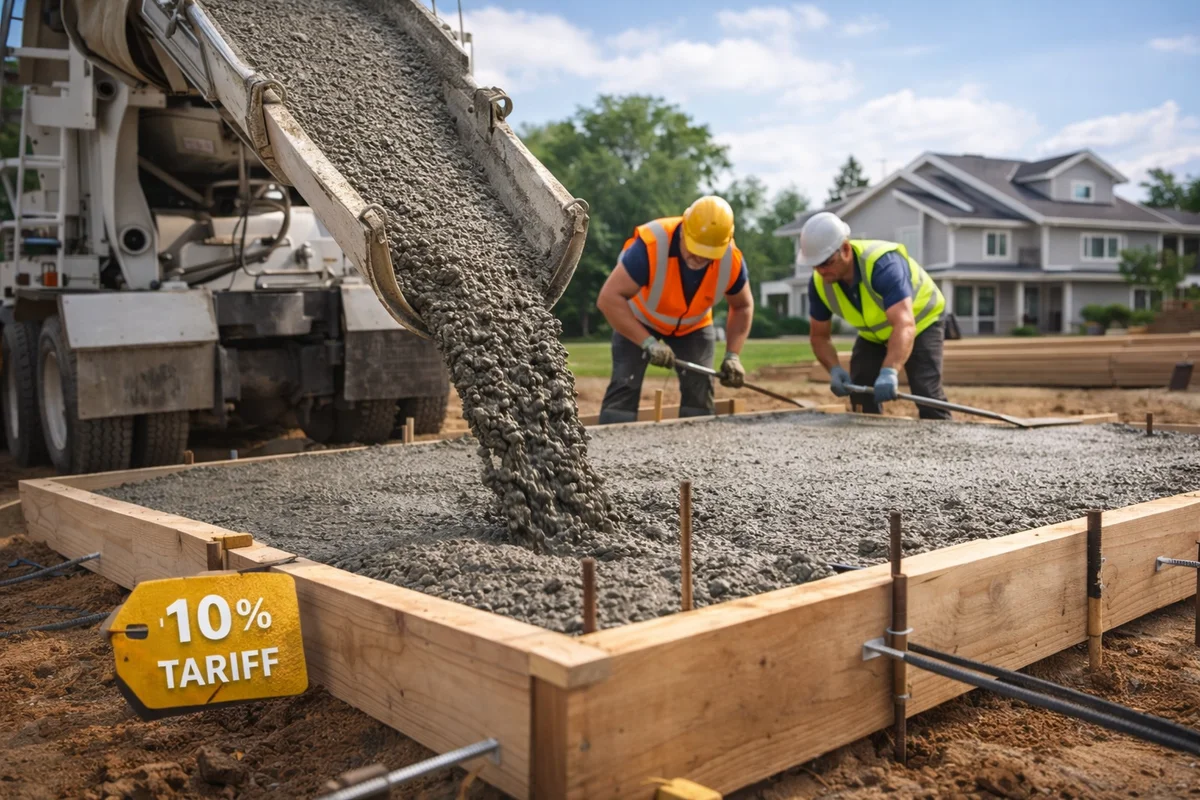
If you've priced a concrete pour recently and noticed the numbers creeping up, you're not imagining it. Concrete costs have risen 3–7% from 2025 levels, and the forces pushing prices higher aren't going away anytime soon.
Most cost guides online will give you a range — $125 to $200 per cubic yard — and leave it at that. But that range is so wide it's almost useless for actual project planning. The real question isn't "what does concrete cost?" It's "why does it cost what it does right now, and what can I do about it?"
This guide breaks down the actual cost drivers behind 2026 concrete pricing, explains how tariffs and cement supply constraints are changing the math, and shows you how to estimate accurately so you're not blindsided on pour day.
What Concrete Actually Costs in 2026
Here's the current pricing landscape based on 2026 industry data:
TABLE:
| Cost Component | 2026 Range | Notes |
|---|---|---|
| Ready-mix concrete (per cubic yard) | $125 – $200 | Standard 3,000–4,000 PSI, delivered within 20 miles |
| Installed cost (per square foot) | $6.50 – $10.50 | Materials + labor for standard slab work |
| Full truckload (10 cubic yards) | $1,100 – $1,500 | Best per-yard rate; avoids short-load fees |
| Short-load fee | $40 – $60 per yard | Added when ordering less than 10 cubic yards |
| Concrete pump rental | $200 – $500 | Required when truck can't reach the pour location |
Regional variation matters enormously. Concrete in New York City averages $180–$250 per cubic yard, while Texas averages $110–$165. The same driveway pour can cost 40–60% more depending on your metro area. This is why a national average is nearly meaningless for your specific project.
Use our free concrete calculator to get a cost estimate adjusted for your state and project specifications. Concrete Calculator - CostFlowAI
Why Concrete Prices Climbed in 2026
Three forces are converging to push concrete costs higher. Understanding them helps you anticipate where prices are heading — and where you might have negotiating room.
1. Cement Tariffs: The 25% Import Problem
The U.S. imports roughly 20% of its cement. According to 2023 data cited by the Portland Cement Association, Canada supplies approximately 5 million metric tons and Mexico supplies roughly 2 million metric tons annually — together accounting for about 27% of all U.S. cement imports. When 25% tariffs hit imports from both countries, the pricing math changed immediately.
The PCA acknowledged alignment with the administration's goals of strengthening domestic manufacturing but cautioned that the tariffs risk raising construction costs, straining energy markets, and slowing infrastructure work that depends on affordable cement. In northern states like New York and Washington, Canadian imports account for up to 36% of cement consumption. Those regions felt the price impact first and hardest.
Here's what the tariff effect looks like on typical residential pours:
TABLE:
| Project Type | Concrete Needed | Pre-Tariff Cost (est.) | 2026 Cost (est.) | Estimated Tariff Impact |
|---|---|---|---|---|
| 4" driveway (20×30 ft) | ~7.5 cubic yards | $900 – $1,125 | $940 – $1,500 | +$40 – $375 |
| Garage slab (24×24 ft, 4") | ~7 cubic yards | $840 – $1,050 | $875 – $1,400 | +$35 – $350 |
| Patio (12×16 ft, 4") | ~2.5 cubic yards | $300 – $375 | $313 – $500 | +$13 – $125 |
| Foundation (1,500 sq ft home) | ~25–35 cubic yards | $3,000 – $5,250 | $3,125 – $7,000 | +$125 – $1,750 |
Calculated based on 2025 vs. 2026 per-yard pricing ranges from multiple industry sources. Actual tariff impact varies by region, supplier, and cement source. These estimates illustrate the range of impact, not guaranteed costs.
The tariff doesn't add 25% to your concrete bill directly. Cement is roughly 10–15% of ready-mix concrete's total cost. But when the tariff ripples through the supply chain — affecting production costs, energy, and transportation — the cumulative impact on a large pour is real.
The capacity problem is worse than the tariff itself. Building a new cement plant takes 2–3 years from approval to production. Even if domestic producers wanted to replace every imported ton tomorrow, they can't scale fast enough. This means tariff-driven price increases won't self-correct quickly.
2. Rebar and Steel Reinforcement: Up 5–10%
Concrete doesn't work alone. Nearly every structural pour requires steel reinforcement, and rebar prices have climbed 5–10% due to the 25% duties on steel and aluminum imports. According to accounting and advisory firm Baker Tilly, even domestically produced concrete is affected because components like aluminum — used in some cement production processes — carry import costs that feed into the final price.
Current rebar pricing in 2026:
TABLE:
| Rebar Type | Cost Per Linear Foot | Cost Per Ton |
|---|---|---|
| Standard carbon steel (#3–#5) | $0.40 – $2.25 | $1,300 – $2,000 |
| Epoxy-coated | $1.20 – $1.60 | $1,800 – $2,400 |
| Galvanized | $1.20 – $1.60 | $1,800 – $2,400 |
| Stainless steel | $3.50 – $9.00 | $5,000+ |
For a typical residential driveway requiring 120–150 linear feet of rebar, the steel tariff adds $15–$50 to the reinforcement cost alone. On a foundation pour with 500+ linear feet, that number grows to $75–$250.
One piece of positive context: structural steel prices dropped to $2,344 per ton in January 2026, down 7.2% year-over-year according to Gordian's RSMeans data. The broader steel market is softening. But rebar pricing hasn't followed the same trajectory because concrete reinforcement demand remains high, driven by infrastructure spending.
3. Infrastructure Spending: Competing for the Same Supply
The Infrastructure Investment and Jobs Act (IIJA) continues to fund highway, bridge, and municipal projects through late 2026. That's positive for the economy — but it means your residential driveway pour is competing with DOT highway projects for the same ready-mix trucks, the same cement supply, and the same concrete crews.
Industry analyst Ed Sullivan of The Sullivan Report projects U.S. cement consumption at around 100 million tons in 2026 — the expected bottom of a multi-year demand cycle. But that "bottom" is misleading for homeowners. The decline is in overall national volume, not necessarily in your local market's pricing. Public infrastructure projects get priority scheduling and bulk pricing, which can crowd out smaller residential pours, particularly in metro areas with active highway work.
The scheduling impact is often worse than the price impact. If your local ready-mix plants are running trucks to a highway project all week, your Saturday driveway pour might get bumped — or you'll pay premium rates for weekend delivery.
I've lived this firsthand. A highway project near one of my residential jobs tied up the local ready-mix plant's trucks all week. My driveway pour got pushed to Saturday — which meant weekend delivery premiums I never budgeted for. Now I'm scrambling to find the cost delta, and that premium became a lesson I won't forget. Since then, I always set aside a contingency buffer specifically for scheduling disruptions. If there's active infrastructure work near your project, assume your pour date is flexible and budget accordingly.
The Costs Nobody Tells You About
The per-yard price is just the starting point. These additional costs catch homeowners off guard consistently:
Short-load fees add $40–$60 per cubic yard when you order less than a full truckload (10 yards). That patio pour requiring 2.5 yards? The short-load surcharge can add $100–$150 to your total.
Overtime charges kick in when the truck sits longer than 7–8 minutes per cubic yard during unloading. At roughly $70/hour, a poorly prepared jobsite can add $140+ to a single pour. Having forms set, rebar placed, and a crew ready before the truck arrives isn't just good practice — it's money in your pocket.
Weekend delivery premiums of $8–$10 per cubic yard are standard at most plants. A 10-yard Saturday pour costs $80–$100 more than the same pour on a Tuesday.
Pump truck rental runs $200–$500 when the concrete truck can't reach your pour location. Backyard patios, basement work, and any pour more than 200 feet from truck access typically require pumping.
Winter surcharges of $5–$7 per cubic yard cover heated materials and cold-weather additives. If you're pouring between November and March in northern states, factor this in.
Here's the truth: the more you understand about how concrete work actually gets executed, the fewer surprises you'll face. If you live in a northern state, winter surcharges shouldn't surprise you — they should be a line item in your budget from day one. Know your climate, know your timing.
For homeowners, this is actually an advantage. If your driveway is cracked but functional, you can live with it through the cold season and schedule your pour when warmer weather brings better pricing and availability. That patience can save you hundreds in surcharges and cold-weather additives.
But if you're on a new construction project with a client deadline, you don't have that luxury. You need to account for winter surcharges, potential scheduling delays, and weather-related rework in your original estimate — not discover them mid-project. These aren't surprises. They're foreseeable costs that should be in your contingency from the start.
How to Estimate Concrete Accurately
Most cost overruns happen because concrete is estimated by surface area instead of volume. Concrete is sold by the cubic yard (27 cubic feet), not by the square foot. Here's the formula:
Length (ft) × Width (ft) × Thickness (ft) ÷ 27 = Cubic Yards
Example: A 20 ft × 30 ft driveway at 4 inches thick:
- 20 × 30 × 0.333 ÷ 27 = 7.4 cubic yards
- Add 10% waste factor: 8.1 cubic yards
- At $150/yard delivered: $1,215 for materials
Always add 5–10% for waste. Uneven subgrades, form variations, and spills mean you'll use more than the calculated volume. Ordering too little creates cold joints that compromise structural integrity and trigger expensive re-delivery charges. Ordering one extra yard is always cheaper than a short pour.
The thickness of your slab dramatically changes coverage:
TABLE:
| Slab Thickness | Coverage Per Cubic Yard |
|---|---|
| 4 inches | ~81 square feet |
| 5 inches | ~65 square feet |
| 6 inches | ~54 square feet |
A driveway at 6 inches (required for heavy vehicles) uses 50% more concrete than the same driveway at 4 inches. That's not a rounding error — on a 600 sq ft driveway, it's the difference between 7.4 yards and 11.1 yards, or roughly $555 more in materials.
Our concrete calculator handles these conversions automatically, applies regional pricing, and includes waste factors — so you get an accurate number without the math. [Link Concrete Calculator - CostFlowAI]
What's Actually Cheap Right Now (and What Isn't)
Not everything in concrete work is getting more expensive. Here's where tariffs bite hardest and where you might find relief:
More expensive in 2026:
- Imported cement (25% tariff on Canada/Mexico supply)
- Rebar and wire mesh (steel tariffs adding 5–10%)
- Specialty mixes (high-PSI, fiber-reinforced, colored concrete)
- Labor in metro areas with active infrastructure projects
Relatively stable in 2026:
- Domestically produced cement (rose 1.8% in 2025, forecast to rise just 0.6% in 2026 per IBISWorld)
- Gravel and aggregate (mostly domestic, minimal tariff exposure)
- Standard 3,000 PSI ready-mix in areas with multiple competing plants
- Concrete forms and finishing tools
Potentially cheaper:
- Scheduling pours during weekdays (avoid weekend premiums)
- Ordering full truckloads (eliminate short-load fees)
- Booking in fall/winter (lower demand, more flexible scheduling)
- Getting quotes from 3+ suppliers (competition keeps pricing honest)
How to Protect Your Budget
Based on current market conditions, here are the most effective strategies:
Get three quotes minimum. Ready-mix pricing varies 10–20% between suppliers in the same metro area. The national average is meaningless — your local market is what matters. Ask for itemized quotes that separate material cost, delivery, pumping, and any surcharges.
Lock pricing early. If your project is 2–3 months out, ask about price locks. Some suppliers will guarantee pricing for 30–60 days. With tariff policy still evolving, a price lock protects you from mid-project cost jumps.
Schedule strategically. Tuesday through Thursday pours avoid weekend premiums. Fall and winter scheduling (weather permitting) often comes with better availability and sometimes lower pricing as demand drops seasonally.
Right-size your order. Calculate accurately, add 10% waste, and round up to the nearest half-yard. The short-load fee on an undersized order costs more than an extra half-yard of concrete you didn't need.
Consider combining pours. If your project includes both a driveway and a patio, combining them into a single mobilization saves you a delivery fee ($50–$150) and might push you over the full-truckload threshold, eliminating short-load fees entirely.
I know it sounds disruptive to have both your front and back yard torn up at the same time for prep, formwork, and pours. Especially if you've got little kids and you're constantly redirecting them away from the construction zone on both sides of the house. It's challenging, no question.
But here's my honest take: it's worth it. You save a delivery fee, potentially eliminate the short-load surcharge, and you only deal with the disruption once instead of twice. Yes, you'll have a few uncomfortable days navigating around construction on both ends of your property. But the alternative is paying premium costs for a second pour date that brings its own scheduling headaches. Depending on how close your front door is to the work zone, it's all manageable — and the savings are real.
Where Concrete Prices Are Headed
The Sullivan Report, widely cited in the cement industry, projects 2026 as the bottom of the current demand cycle at around 100 million tons. Several factors suggest prices will stabilize rather than spike further:
Domestically produced cement prices are forecast to rise only 0.6% in 2026 — from $162.9 to $163.9 per metric ton, according to IBISWorld. That's essentially flat after a 1.8% increase in 2025.
Construction activity is expected to remain soft through early 2026 due to tariff uncertainty and elevated interest rates. Softer demand typically prevents aggressive price hikes.
However, the second half of 2026 could see a rebound if interest rates ease and construction activity picks up. In their 2025 full-year earnings report, Cemex — one of the largest global cement producers — projected increased construction activity across all regions and low-single-digit volume growth in 2026.
The wildcard is tariff policy. If the 25% tariffs on Canadian and Mexican cement become permanent, domestic producers may gradually raise prices to capture the gap. If tariffs are reduced or eliminated through negotiation, import supply normalizes and pricing pressure eases.
Bottom line for project planning: If you're on the fence about timing a concrete project, current pricing is elevated but not spiking. The risk of waiting is a potential second-half price increase if demand rebounds. The risk of moving now is paying the current tariff premium. Neither risk is catastrophic — but accurate estimating matters more than ever to avoid waste.
Use the Right Tools
A reliable concrete calculator removes guesswork by converting project dimensions into cubic yards and applying practical waste factors and regional pricing. This mirrors how concrete is estimated on professional projects and prevents last-minute surprises on pour day.
[Link "Concrete Calculator - CostFlowAI"] Try our free concrete calculator →
It handles volume calculations, waste factors, rebar requirements, regional cost adjustments by state, and gives you a professional-grade estimate you can use to compare supplier quotes on equal footing.
CostFlowAI provides preliminary budget planning estimates for educational purposes. Costs vary significantly by region, project complexity, and current market conditions. Always get quotes from licensed concrete contractors before making purchasing decisions.
Try Our Free Concrete Calculator
Calculate concrete volume and cost for your project instantly.
Calculate Now →Related Articles

2026 Construction Tariffs: What They Actually Mean for Your Project Budget
Lumber up 17%, cabinet tariffs at 25%, and more increases possible in 2027. Here's how 2026 tariffs actually affect your renovation and new build costs.
Why Concrete Costs Are Rising and How Contractors Can Adapt
Practical strategies for managing rising concrete costs in 2025. Learn how contractors can adapt to supply chain disruptions and maintain profitability.
Explore More Construction Calculators
Get instant, accurate cost estimates for your next project.
Try the Concrete Calculator