
Why Concrete Costs Are Rising and How Contractors Can Adapt
Practical strategies for managing rising concrete costs in 2025. Learn how contractors can adapt to supply chain disruptions and maintain profitability.
Why Concrete Costs Are Rising and How Contractors Can Adapt
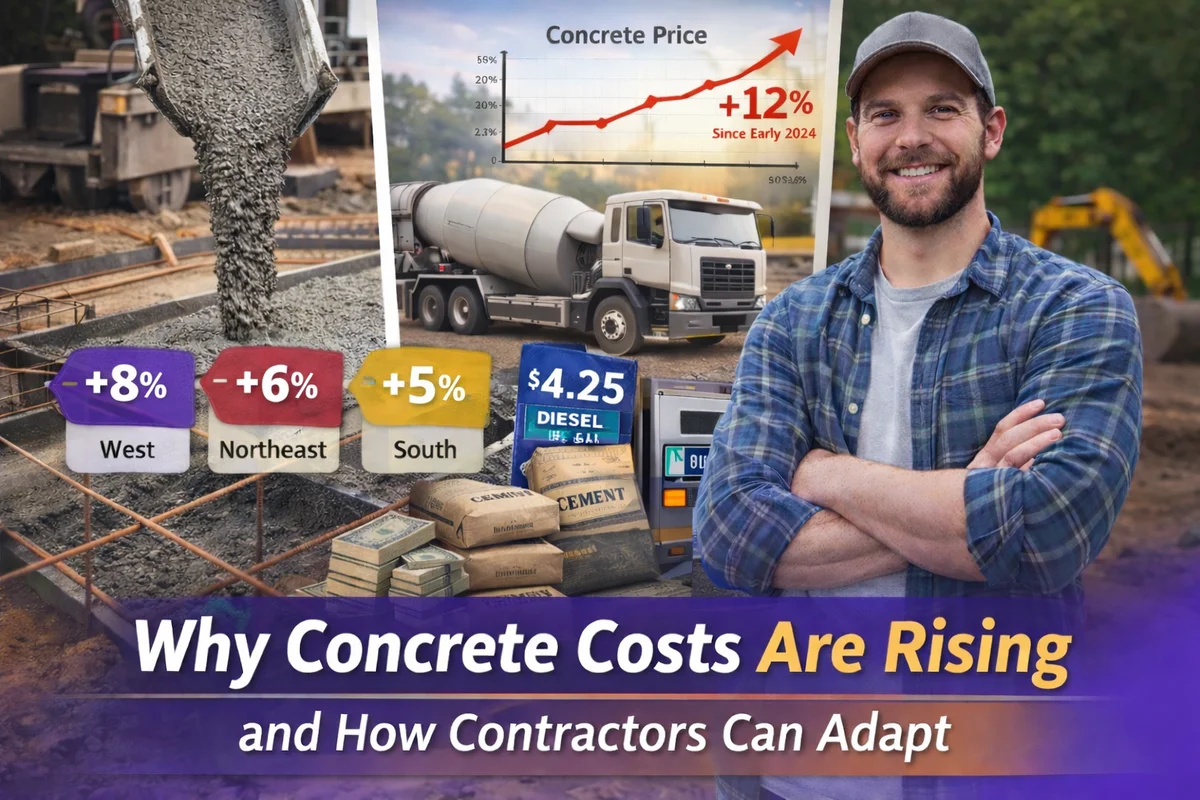
Concrete prices have increased 12–18% since early 2024 in many markets, creating budget challenges for contractors and homeowners alike. Understanding the forces driving these increases—and strategies to manage them—helps you adapt and maintain project viability.
Current Market Conditions
Price Increases by Region
| Region | 2024 Price (per cy) | Current Price | Change |
|---|---|---|---|
| Northeast | $155–$170 | $175–$195 | +12–15% |
| Southeast | $130–$150 | $145–$170 | +12–13% |
| Midwest | $125–$145 | $140–$165 | +12–14% |
| West Coast | $165–$185 | $190–$215 | +15–18% |
| Mountain | $140–$160 | $155–$180 | +11–13% |
Prices reflect ready-mix concrete delivered to job site; actual costs vary by mix design and delivery distance.
What's Driving Price Increases
Supply-Side Pressures
Cement Production Constraints: Domestic cement production is near capacity, with limited new capacity planned. The Portland Cement Association projects demand growth outpacing supply through 2026.
Energy Costs: Cement manufacturing is energy-intensive. While natural gas prices have moderated, electricity costs continue rising in most regions, adding $3–$8 per cubic yard.
Transportation: Diesel fuel costs and driver wages affect delivery expenses. Ready-mix trucks have limited range due to concrete's time sensitivity, concentrating production costs.
Aggregate Shortages: Sand and gravel supplies are constrained in growing metropolitan areas. Some regions report aggregate transport from 50+ miles away.
Demand Factors
Infrastructure Investment: Federal infrastructure spending is creating sustained demand for concrete, particularly for bridges, highways, and water systems.
Residential Construction: Despite higher interest rates, housing demand remains strong in many markets, competing with commercial projects for concrete supply.
Data Center Boom: Large-scale data center construction requires massive concrete volumes, often with priority delivery arrangements.
Impact on Project Budgets
Concrete Cost as Percentage of Project
| Project Type | Concrete % of Total | Impact of 15% Increase |
|---|---|---|
| Foundation only | 15–25% | 2–4% total cost increase |
| Slab construction | 20–35% | 3–5% total cost increase |
| Parking structure | 40–55% | 6–8% total cost increase |
| Concrete building | 35–50% | 5–7% total cost increase |
A 15% concrete price increase doesn't mean 15% project cost increase—but it's significant enough to affect bidding and profitability.
Strategies for Managing Concrete Costs
Planning and Design
Optimize concrete specifications: Don't over-specify. 4000 PSI isn't always necessary where 3000 PSI meets requirements. However, don't under-specify—callback costs exceed material savings.
Value engineering: Work with structural engineers on efficient designs. Reducing slab thickness by 0.5" on a 10,000 sq ft project saves 15+ cubic yards.
Consider alternatives: For some applications, flowable fill, soil cement, or alternative materials may be appropriate at lower cost.
Procurement Strategies
Lock pricing early: Many suppliers offer fixed pricing for 30–90 days. On larger projects, negotiate price guarantees through project completion.
Build relationships: Regular customers with payment history often get priority during shortages and better pricing.
Schedule strategically: Avoid peak season and peak hours when possible. Early morning and late fall pours may offer better availability and pricing.
Order accurately: Over-ordering creates waste; under-ordering costs premium for short-load fills. Invest time in accurate takeoffs.
Contract Protection
Escalation clauses: Include material escalation provisions in contracts, specifying how price increases are handled.
Allowances: Rather than fixed prices, use allowances with defined ranges for volatile materials.
Time limits: Quote validity periods protect against price increases between proposal and acceptance.
What Homeowners Should Know
Timing Considerations
If your concrete project is flexible:
- Spring and fall typically offer best pricing (moderate demand)
- Late summer often sees peak prices (construction season peak)
- Winter in northern climates may offer discounts but weather risks
Getting Accurate Bids
In a rising-price environment:
- Get bids within a 2-week window for fair comparison
- Ask how long quotes are valid
- Inquire about price adjustment provisions
- Be prepared to make decisions quickly
Budget Padding
Add 10–15% contingency for concrete work in current conditions, beyond normal estimating practices. This accounts for both price movement and potential scope adjustments.
Market Outlook
Most industry analysts expect concrete prices to stabilize in late 2025, with modest increases (3–5% annually) thereafter. Major factors to watch:
Positive signs: New cement production coming online in 2026, moderating energy costs, housing market cooling
Risk factors: Continued infrastructure spending, supply chain disruptions, extreme weather affecting production
Next Steps
Use our Concrete Calculator to estimate current project costs based on your dimensions and local pricing.
For significant projects, request quotes from multiple ready-mix suppliers and compare not just price but reliability, service quality, and payment terms.
Try Our Free Concrete Calculator
Calculate concrete volume and cost for your project instantly.
Calculate Now →Related Articles
Concrete Costs 2026: Tariffs, Shortages & Budget Guide
Concrete costs have risen 3–7% from 2025. This guide breaks down how tariffs, cement shortages, and infrastructure spending are affecting prices — and how to protect your budget.

2026 Construction Tariffs: What They Actually Mean for Your Project Budget
Lumber up 17%, cabinet tariffs at 25%, and more increases possible in 2027. Here's how 2026 tariffs actually affect your renovation and new build costs.
Explore More Construction Calculators
Get instant, accurate cost estimates for your next project.
Try the Concrete Calculator