
Drywall Costs in 2025: Installation Pricing and Material Guide
Drywall installation costs $1.50-$3.50 per square foot, with a typical room costing $500-$1,500. Learn what affects pricing and how to estimate materials accurately.
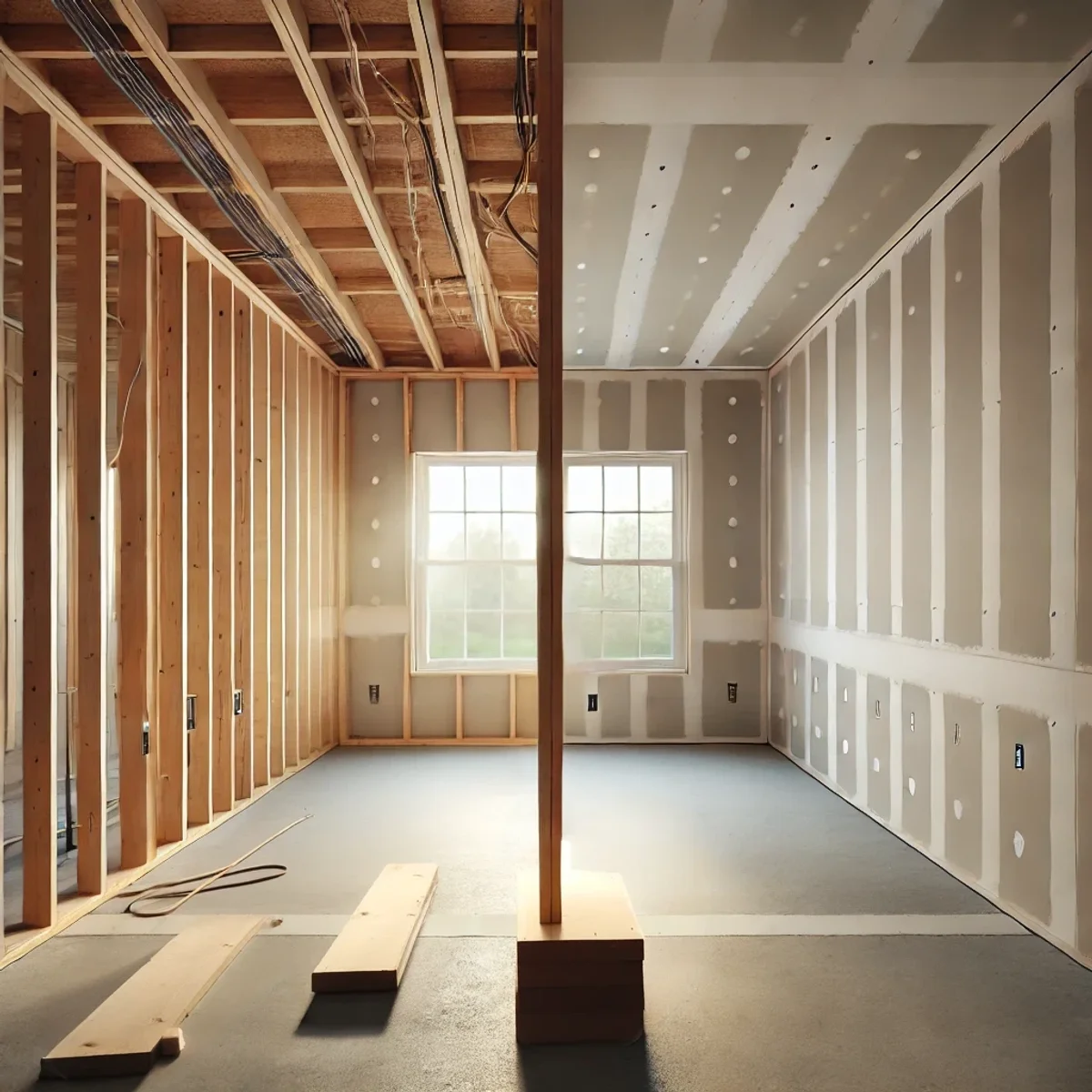
Drywall Costs in 2025: Installation Pricing and Material Guide
Drywall installation is one of the most predictable construction costs, but prices vary significantly based on finish level, ceiling height, and regional labor markets. Understanding these factors helps you budget accurately for renovation or new construction projects.
Current Drywall Pricing (2025)
Material Costs
| Drywall Type | Price per Sheet (4×8) | Price per Sq Ft |
|---|---|---|
| Standard 1/2" | $12–$18 | $0.38–$0.56 |
| Moisture-resistant | $14–$22 | $0.44–$0.69 |
| Fire-rated (Type X) | $16–$24 | $0.50–$0.75 |
| Soundproof | $45–$65 | $1.40–$2.03 |
Standard 1/2" drywall covers most residential applications. Moisture-resistant ("green board") is required in bathrooms and kitchens. Fire-rated Type X is code-required for garage walls adjacent to living spaces and multi-family separations.
Installed Costs (Including Labor)
| Service Level | Cost per Sq Ft | Typical Room (12×12) |
|---|---|---|
| Hang only | $0.75–$1.25 | $432–$720 |
| Hang + tape (Level 3) | $1.25–$2.00 | $720–$1,152 |
| Full finish (Level 4) | $1.75–$2.75 | $1,008–$1,584 |
| Premium finish (Level 5) | $2.50–$3.50 | $1,440–$2,016 |
Finish Level Definitions:
- Level 3: Tape embedded, one coat compound—suitable for texture or tile backer
- Level 4: Two coats compound, light sanding—standard for painted walls
- Level 5: Skim coat entire surface—required for gloss paint or critical lighting
What Affects Drywall Costs
Ceiling Height: Standard 8-foot ceilings use efficient 4×8 sheets. 9-10 foot ceilings require 4×10 or 4×12 sheets (more expensive, harder to handle) or additional cutting and seams.
Texture vs. Smooth: Textured finishes (orange peel, knockdown) add $0.25–$0.50 per square foot but hide imperfections. Smooth finishes require Level 5 prep—more labor-intensive and costly.
Accessibility: Open rooms with easy access cost less than tight spaces, stairwells, or areas requiring scaffolding. Second-floor work adds 10–20% for material handling.
Demolition: Removing old drywall adds $0.50–$1.50 per square foot plus disposal fees ($200–$500 for a typical renovation).
Regional Cost Variations
| Region | Labor Rate | Installed Cost Range |
|---|---|---|
| Northeast | $20–$35/hr | $2.00–$3.50/sq ft |
| Southeast | $15–$25/hr | $1.50–$2.75/sq ft |
| Midwest | $16–$28/hr | $1.50–$2.75/sq ft |
| West Coast | $25–$45/hr | $2.25–$4.00/sq ft |
| Mountain West | $18–$30/hr | $1.75–$3.00/sq ft |
Urban areas run 15–25% higher than rural locations due to higher labor costs and parking/access challenges.
How to Calculate Drywall Needs
Basic Formula
Total wall area + Ceiling area = Gross square footage
For a 12×14 room with 8-foot ceilings:
- Walls: (12+14+12+14) × 8 = 416 sq ft
- Ceiling: 12 × 14 = 168 sq ft
- Gross total: 584 sq ft
Deduct Openings (Partially)
Standard practice is to deduct 50% of door and window areas:
- Typical door: 21 sq ft × 0.5 = 10.5 sq ft
- Typical window: 15 sq ft × 0.5 = 7.5 sq ft
If our room has one door and two windows:
- Deduction: 10.5 + 7.5 + 7.5 = 25.5 sq ft
- Net area: 584 – 25.5 = 558.5 sq ft
Convert to Sheets
Each 4×8 sheet covers 32 sq ft:
- 558.5 ÷ 32 = 17.5 sheets
- Add 10% waste: 17.5 × 1.10 = 19 sheets
DIY vs. Professional Installation
DIY-Friendly Tasks:
- Hanging drywall in accessible areas
- Basic taping and mudding (with practice)
- Texture application (some types)
Leave to Professionals:
- Ceilings (heavy, awkward, safety concerns)
- Level 5 finishes (skill-intensive)
- Large projects (time and quality consistency)
- Anything requiring scaffolding
A skilled DIYer can save 50–60% on labor costs but should expect their first project to take 3–4 times longer than a professional crew.
Common Drywall Mistakes to Avoid
Using wrong thickness: 1/2" is standard for walls; 5/8" is required for ceilings spanning 24" on center (prevents sagging). Using 1/2" on wide-spanned ceilings leads to waviness over time.
Insufficient fasteners: Code requires screws every 12" on walls, 8" on ceilings. Under-fastening leads to popped screws and loose panels.
Poor joint treatment: Rushing the mudding process creates visible seams. Three thin coats beat two thick coats every time. Allow 24 hours drying between coats.
Ignoring humidity: Don't hang drywall in unconditioned spaces during humid months. Moisture absorbed during installation can lead to mold or sagging.
Frequently Asked Questions
How long does drywall installation take? A professional crew can hang and finish a typical room (400–600 sq ft) in 3–4 days, including drying time between mud coats. DIY projects take 2–3 weeks for the same scope.
Should I repair or replace damaged drywall? Small holes and cracks (under 6 inches): Patch and repair ($50–$150 per spot) Large damage or water-affected areas: Cut out and replace section ($200–$500) Extensive damage or mold: Full replacement required
What's the difference between drywall and sheetrock? Sheetrock is a brand name (USG Corporation) for drywall. It's like Kleenex vs. tissue—same product, brand name became generic term.
Next Steps
Use our Drywall Calculator to estimate sheets needed for your project, including waste factors and material costs.
For projects over 1,000 square feet or requiring Level 5 finish, we recommend getting professional quotes to compare against DIY costs and timeline.
Try Our Free Drywall Calculator
Calculate drywall sheets needed for your project instantly.
Calculate Now →Related Articles
 Featured
Asphalt Paving Costs in 2025: Driveway and Parking Lot Pricing Guide
Asphalt paving costs $3-$7 per square foot installed, with driveways averaging $4,500-$9,000. Learn what affects pricing and how to plan your paving project.
 Featured
Framing Costs in 2025: Lumber Pricing and Structural Construction Guide
Framing costs $7-$16 per square foot, with lumber prices stabilizing after 2021-2022 volatility. Learn what affects structural framing costs for your building project.
 Featured
Concrete Costs in 2025: What Every Homeowner and Contractor Should Know
Current concrete pricing ranges from $135-$185 per cubic yard, with installed costs of $6-$14 per square foot. Learn what drives these costs and how to estimate accurately for your project.
Explore More Construction Calculators
Get instant, accurate cost estimates for your next project.
Try the Drywall Calculator