
What Drives Concrete Slab Cost in 2026
Concrete slab costs $6–$12 per sq ft installed in 2026. A construction PM breaks down thickness, rebar, site prep, regional pricing, and what every bid must include.
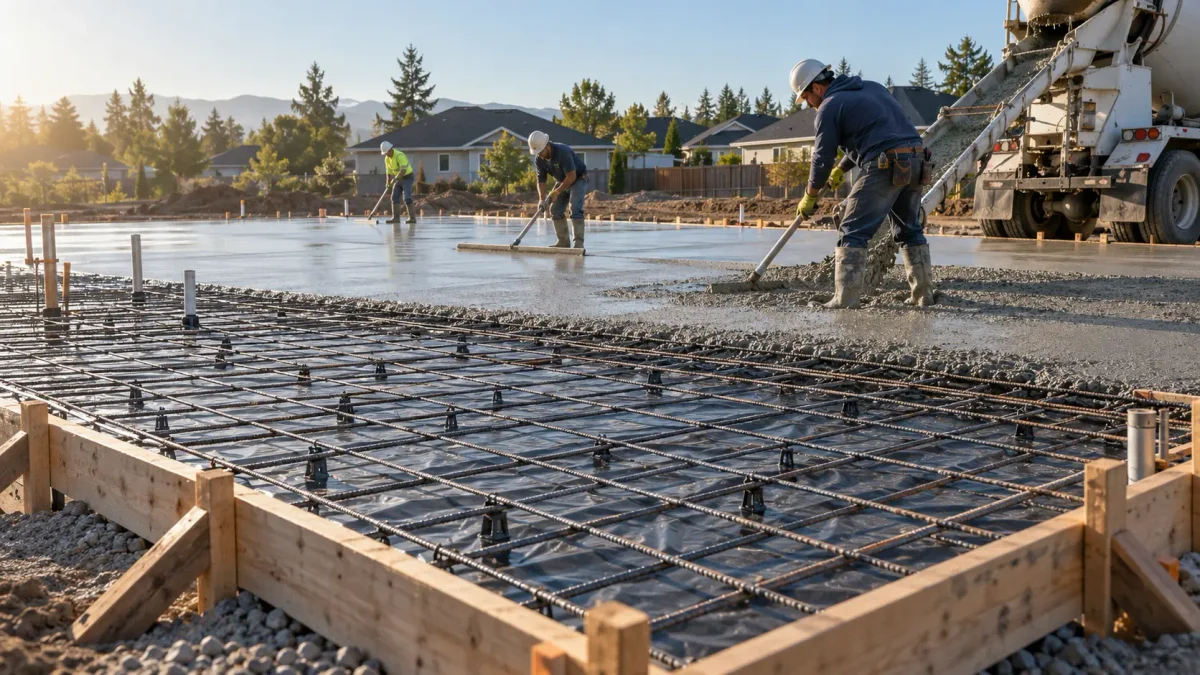
Most people want one number for a concrete slab. The honest answer is a range, because two slabs of the same size can land 40% apart depending on how thick they are, what goes underneath, and how the truck reaches the forms.
If you just want the number for your dimensions, run them through the concrete calculator. It gives you volume, ready-mix cost, and an installed range in a few seconds. This guide covers the other half: why your quote reads the way it does, and where the money actually goes.
The short version on price
For 2026, a plain broom-finish slab runs about $5 to $8 per square foot installed for most residential work. A basic patio or walkway sits near the bottom of that. A driveway or garage slab runs higher because it's usually thicker and takes more reinforcement. Decorative work like stamped or exposed aggregate can push past $12 per square foot once you add the finishing labor.
Ready-mix is the anchor. Delivered concrete is running $145 to $185 per cubic yard in most markets, with $160 a fair mid-point. One yard covers about 81 square feet at 4 inches thick, so the concrete alone on a 400-square-foot patio is roughly $800 to $950 before anyone picks up a trowel.
What actually moves the number
Thickness. This is the driver people underestimate. A slab is priced by volume, and volume scales straight with thickness. Going from 4 inches to 5 isn't a rounding error, it's 25% more concrete. Patios and walkways are fine at 4 inches. Driveways that carry a truck or an RV want 5 to 6. That extra inch shows up twice: in the concrete bill now, and in the removal cost later.
Reinforcement. Wire mesh is the cheap option, about $0.35 per square foot in place. Move up to #3 rebar and you're near $0.75; #4 rebar on a grid runs around $1.10. Some slabs get both mesh and bar, closer to $1.50. This isn't padding. A driveway carrying vehicle loads over soft soil needs more steel than a garden path.
Site prep. A slab is only as good as what's under it. A compacted 4-inch gravel base adds roughly $0.75 per square foot; 6 inches runs about $1.10; engineered fill on bad soil can hit $2.50. When a bid looks low, this is the first place to check, because skipping base prep is how slabs crack and heave in three winters.
Getting the concrete to the forms. If the truck can back up and chute it in, you pay nothing extra. If the pour is in a backyard, uphill, or past a fence, you need a pump. A pump adds around $450 at minimum and climbs with volume. On a tight lot this line surprises people, so ask about access before you sign.
Finish. A broom finish is standard and already in the base price. A smooth trowel is a touch more. Stamped or stained concrete roughly doubles the finishing labor, which is why a stamped patio can cost as much as the structural slab under it.
How to read a real slab quote
A calculator gives you a fair number. A contractor's quote tells you what they're actually going to do. Line the two up and look for these:
- Thickness and PSI, in writing. "4-inch, 3000 PSI" is normal residential. If the quote doesn't say, ask. A thinner or weaker pour is the easiest corner to cut where you'll never see it.
- What's under the slab. Base material, depth, and compaction should be spelled out. "Prep included" with no detail is a soft spot.
- Reinforcement type and spacing. Mesh, rebar, or both. This tells you whether the slab is built for the load you're putting on it.
- Control joints. Every slab cracks; joints decide where. Good practice is a joint every 8 to 10 feet. If nobody mentions them, that's a flag.
- Removal and haul-off. Tearing out an old slab isn't free. Figure roughly $4 per square foot to demo and haul a 4-inch slab, more as it gets thicker. If you have existing concrete, it should be its own line.
- Washout and cleanup. Excess spoil and the pump truck need somewhere to go. Vague quotes leave this to "extras."
If two bids are $2,000 apart, the gap is almost always in these lines, not in the price of concrete. The cheaper bid is usually thinner, has less steel, or is skipping base prep.
A few things worth knowing before pour day
Concrete needs about 28 days to reach full strength, though you can walk on it in a day or two and drive on it in a week. Cooler weather, roughly 50 to 70 degrees, gives a better, slower cure than a hot afternoon. And keep the forms and subgrade damp before the pour so the dry ground doesn't pull water out of the mix.
Frequently Asked Questions
How much does a 20x20 concrete slab cost?
A 400-square-foot slab at 4 inches needs about 5 cubic yards of concrete once you add waste. For a plain broom finish, most homeowners land between $2,000 and $3,400 installed, depending on region, base prep, and reinforcement. The concrete itself is only around $850 of that; the rest is labor, prep, and forms.
Is it cheaper to pour concrete yourself?
For a small pad, bagged concrete and a weekend can save you the labor, which is often half the job. Past about a cubic yard, roughly a 9x9 slab at 4 inches, bags stop making sense and you want ready-mix delivered. The catch is finishing. A bad float or trowel job is permanent, and fixing it costs more than hiring it out would have.
How thick should my slab be?
Four inches handles patios, walkways, and shed floors. Driveways and garage slabs want 5 to 6 inches, especially if a heavy vehicle parks on them. Thickness is cheap insurance next to replacing a cracked slab.
Why is my quote so much higher than the calculator?
A calculator prices the slab itself. Your quote may add tear-out of an old slab, a pump for tight access, thicker concrete, decorative finishing, or a stronger mix. Each of those is a real cost. Ask the contractor to itemize, then compare line by line against the estimate.
What makes concrete crack, and can I prevent it?
All concrete cracks as it cures and moves with temperature. You can't stop it, but control joints steer cracks into straight, planned lines instead of random ones. Solid base prep and not overwatering the mix do the rest. Cut or tool joints every 8 to 10 feet.
Try Our Free Concrete Calculator
Calculate concrete volume and cost for your project instantly.
Calculate Now →Related Articles
How Much Does It Cost to Pour a Concrete Driveway in 2026?
A concrete driveway costs $6.80-$11.90 per square foot for a plain slab in 2026. A PM breaks down thickness, rebar, base, removal, and bid red flags.
Deck Cost Per Square Foot by Material (2026)
Decks cost $20–$80/SF installed in 2026 by material. A PM breaks down PT wood, composite, and PVC pricing, plus labor, footings, and railing.
How the 2026 Energy Crisis Is Affecting U.S. Construction Material Prices
The Strait of Hormuz crisis is driving up diesel, steel, asphalt, and concrete costs across U.S. construction. Here's what the data shows and what to do now.
Explore More Construction Calculators
Get an instant budget range for your next project — free, with the math shown.
Try the Concrete Calculator