
How Much Does It Cost to Pour a Concrete Driveway in 2026?
A concrete driveway costs $6.80-$11.90 per square foot for a plain slab in 2026. A PM breaks down thickness, rebar, base, removal, and bid red flags.
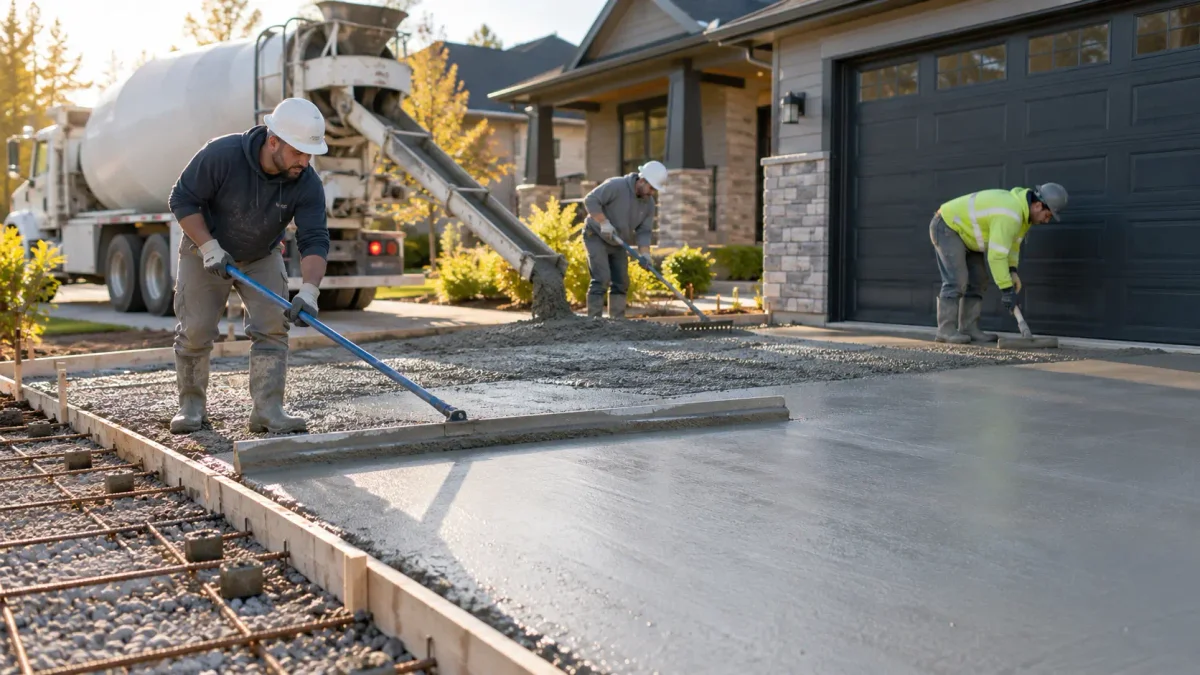
What a Concrete Driveway Costs in 2026
A concrete driveway is one of the most durable surfaces you can pour, but the price swings widely with finish and reinforcement. The planning number that matters is installed cost per square foot — concrete, forms, reinforcement, base prep, finishing, and labor. Here is what contractors are quoting in 2026:
| Finish Type | Installed Cost/SF | 2-Car Driveway (600 SF) | Notes |
|---|---|---|---|
| Plain / broom finish | $6–$10 | $3,600–$6,000 | Standard gray, 4” slab |
| Basic decorative (color or exposed aggregate) | $10–$15 | $6,000–$9,000 | Integral color, seeded aggregate |
| Mid-range decorative (stamped) | $15–$20 | $9,000–$12,000 | Single-pattern stamp |
| High-end decorative (stamped + color + borders) | $20–$25+ | $12,000–$15,000+ | Multi-color, banding, sealers |
A reality check: if a bid comes in at $4/SF on a new pour, the contractor is almost certainly skipping the gravel base, the reinforcement, or proper control joints — the three things that keep a driveway from cracking apart in five years. The cheap pour is the expensive pour once you tear it out and redo it.
Why Concrete Driveways Cost More in 2026
Concrete pricing has climbed steadily, and 2026 is no exception. Cement — the binding ingredient in every yard of concrete — rose 7.7% year-over-year, and that increase is amplified by trade policy: 25% tariffs on Mexican and Canadian cement hit a market where the U.S. imports a meaningful share of its supply. Reinforcing steel is caught in the same Section 232 50% tariff regime driving up rebar and wire mesh. Layer on a tight finishing-labor market, and the result is that the overall construction materials Producer Price Index ran up 6.0% year-over-year through early 2026. Budget at today's numbers and treat any tariff rollback as upside, not a reason to wait.
Thickness, Rebar, and Base: What Actually Drives the Number
Two driveways at the same square footage can differ by thousands of dollars based on what is under and inside the slab. These are the specs that move the price — and the ones worth paying for.
Slab thickness: 4” vs. 6”
A standard residential driveway is poured 4 inches thick over a compacted base. Going to 5 or 6 inches — worth it if you park trucks, RVs, or trailers — adds roughly $1.50–$2.50 per square foot because you are buying 25–50% more concrete plus heavier reinforcement. On a 600 SF driveway, that is $900–$1,500 well spent if heavy vehicles are in the picture.
Reinforcement: rebar vs. wire mesh
Rebar grid (#3 or #4 bar at 12”–18” on center) adds about $0.50–$1.00 per square foot in material and is the right choice for driveways carrying real weight. Welded wire mesh is cheaper but easy to install wrong — if it ends up lying on the ground instead of suspended in the middle of the slab, it does nothing. A bid with no reinforcement line item is a red flag.
Base and drainage
A 4–6 inch compacted gravel base is non-negotiable; it is what prevents settling and frost heave. Proper slope (a minimum of 1–2% away from the house) and control joints cut every 8–12 feet are what keep the slab from cracking. None of this is glamorous, and all of it is where cheap bids cut.
Don't Forget Demolition: Removing the Old Driveway
If you are replacing an existing driveway, removal is a separate and meaningful cost. Tearing out and hauling off old concrete runs $2–$4 per square foot for plain slabs — roughly $800–$1,600 on a two-car driveway. If the old slab is reinforced with rebar, demolition can reach $6 per square foot because it requires heavier equipment and more labor. Make sure removal and disposal appear as their own line item; “tear-out included” with no number attached is how a bid hides cost.
Concrete Driveway Cost by Size in 2026
Driveways are priced by area, so size drives the total directly. Here are typical installed ranges for plain versus stamped finishes:
| Driveway Size | Area | Plain Finish | Stamped/Decorative |
|---|---|---|---|
| 1-car (12x24) | 288 SF | $1,750–$2,900 | $4,300–$7,200 |
| 2-car (20x30) | 600 SF | $3,600–$6,000 | $9,000–$15,000 |
| 3-car (30x30) | 900 SF | $5,400–$9,000 | $13,500–$22,500 |
| Long / rural (16x80) | 1,280 SF | $7,700–$12,800 | $19,200–$32,000 |
Add for site conditions: poor soil, a sloped lot, removal of trees or roots, or a driveway that needs a retaining edge will all push the number up. A simple, flat, rectangular pour on good soil is the cheapest scenario per square foot.
Regional Price Variation and Timing
Concrete pricing varies 30–50% by region, and unlike a lot of materials, a big share of that is the concrete itself — ready-mix is heavy and expensive to truck, so prices track local plant capacity and haul distance.
Lower-cost markets (Southeast, Texas, Midwest)
Plain driveways commonly run $6–$8/SF installed. Year-round pour weather and dense ready-mix supply keep both material and labor competitive. A 600 SF driveway often falls between $3,600 and $5,000.
Higher-cost markets (Northeast, West Coast, Mountain West)
Expect $9–$12/SF for the same plain pour. Shorter pour seasons, longer haul distances, and stricter base and reinforcement requirements in freeze-thaw climates all add cost. Thicker slabs and deeper compacted base are common, pushing a 600 SF driveway to $6,000–$8,000 before any decorative finish.
Timing matters
Concrete is a weather-dependent trade. Pouring in freezing temperatures requires blankets, accelerators, or heated enclosures that add cost, and extreme heat forces early-morning pours. Scheduling in spring or fall — and booking early, before the summer rush — is the cheapest and lowest-risk window in most of the country.
Concrete vs. Asphalt vs. Pavers
Concrete is not always the answer — here is the honest comparison so you can match the surface to your budget and climate:
| Surface | Installed Cost/SF | Lifespan | Best For |
|---|---|---|---|
| Gravel | $1–$3 | 5–10 yrs (regrade) | Long rural drives, tight budgets |
| Asphalt | $3–$7 | 15–20 yrs | Cold climates, lower upfront cost |
| Concrete | $6–$25 | 30–40 yrs | Durability, low maintenance, design options |
| Pavers | $15–$30 | 30–50 yrs | High-end curb appeal, repairability |
Concrete costs more upfront than asphalt but typically lasts twice as long with less maintenance, which is why it usually wins on total cost of ownership in moderate climates. In regions with hard freeze-thaw cycles and heavy road-salt use, asphalt can be the more forgiving choice.
What a Legitimate Driveway Bid Should Include
A driveway bid should read like a spec, not a single number. Make sure each of these appears:
- Slab thickness (4” standard, 5–6” for heavy vehicles)
- Concrete strength (PSI — 4,000 PSI is standard for driveways)
- Reinforcement type and spacing (rebar grid or wire mesh, sized)
- Base prep: gravel type and compacted depth (4–6”)
- Control joint spacing and method (sawcut or tooled, every 8–12 ft)
- Slope/drainage plan (minimum 1–2% away from structures)
- Demolition and disposal of the old driveway, as a separate line
- Finish type (broom, exposed aggregate, stamped) and sealer if applicable
- Cure time and access restrictions communicated up front
Red flags in a driveway bid
- Lump-sum price with no thickness, PSI, or reinforcement listed
- No gravel base or compaction mentioned
- No control-joint plan — guarantees random cracking
- “Removal included” with no separate demolition figure
- Deposit over 30–40% before any material is delivered
Get Your Driveway Estimate in 60 Seconds
The ranges above are planning numbers, not bids. Thickness, reinforcement, finish, removal, and your local market all move the final figure. Here is the process I recommend:
- Run your numbers. Use our free concrete calculator to enter your driveway dimensions, thickness, and finish. You get an itemized estimate — cubic yards, reinforcement, base, and labor — with regional pricing built in.
- Get three written bids and use your calculated range as the benchmark. A bid more than 25% off your range deserves a conversation.
- Compare the spec, not the bottom line. The cheapest bid is usually the one skipping base prep or reinforcement.
Try the Free Concrete Cost Calculator
Try Concrete Calculator →Get cubic yards, reinforcement quantities, and a total budget range in under 60 seconds. Regional pricing for all 50 states. Full math shown. No signup required.
Frequently Asked Questions
How much does a 2-car concrete driveway cost in 2026?
A standard 2-car (600 SF) plain concrete driveway runs $3,600–$6,000 installed in 2026. Decorative finishes raise that to $9,000–$15,000, and removing an old driveway adds $1,200–$2,400.
How thick should a concrete driveway be?
Four inches is standard for passenger vehicles. Step up to 5–6 inches with rebar reinforcement if you park trucks, RVs, or trailers — it adds about $1.50–$2.50 per square foot but prevents cracking under heavy loads.
Do I need rebar or is wire mesh enough?
For a driveway carrying real weight, rebar grid is the safer choice and adds $0.50–$1.00 per square foot. Wire mesh is cheaper but only works if it is suspended in the middle of the slab during the pour — it is frequently installed wrong. Either way, some reinforcement should always be specified.
How long before I can drive on a new concrete driveway?
Plan on staying off it for 7 days with foot traffic only, and wait a full 28 days before parking heavy vehicles. Concrete reaches most of its strength in the first month, and driving on it too early causes cracks that void many workmanship warranties.
Is concrete or asphalt cheaper for a driveway?
Asphalt is cheaper upfront at $3–$7 per square foot versus $6–$25 for concrete. But concrete lasts 30–40 years with less maintenance versus 15–20 for asphalt, so concrete usually wins on total cost of ownership in moderate climates.
Data as of June 2026. Cost ranges based on BLS Producer Price Index data, ABC and NAHB construction cost reports, Concrete Network and Homewyse pricing data, and national contractor pricing surveys. All estimates are for planning purposes. Actual costs vary by region, project complexity, and market conditions. Always obtain multiple bids from licensed contractors.
Try Our Free Concrete Calculator
Calculate concrete volume and cost for your project instantly.
Calculate Now →Related Articles
Deck Cost Per Square Foot by Material (2026)
Decks cost $20–$80/SF installed in 2026 by material. A PM breaks down PT wood, composite, and PVC pricing, plus labor, footings, and railing.
How the 2026 Energy Crisis Is Affecting U.S. Construction Material Prices
The Strait of Hormuz crisis is driving up diesel, steel, asphalt, and concrete costs across U.S. construction. Here's what the data shows and what to do now.

How to Read a Contractor's Estimate (And Catch What's Missing)
A construction PM explains every section of a contractor's estimate — line items, red flags, allowances, and how to compare bids before you sign.
Explore More Construction Calculators
Get an instant budget range for your next project — free, with the math shown.
Try the Concrete Calculator