
Deck Cost Per Square Foot by Material (2026)
Decks cost $20–$80/SF installed in 2026 by material. A PM breaks down PT wood, composite, and PVC pricing, plus labor, footings, and railing.
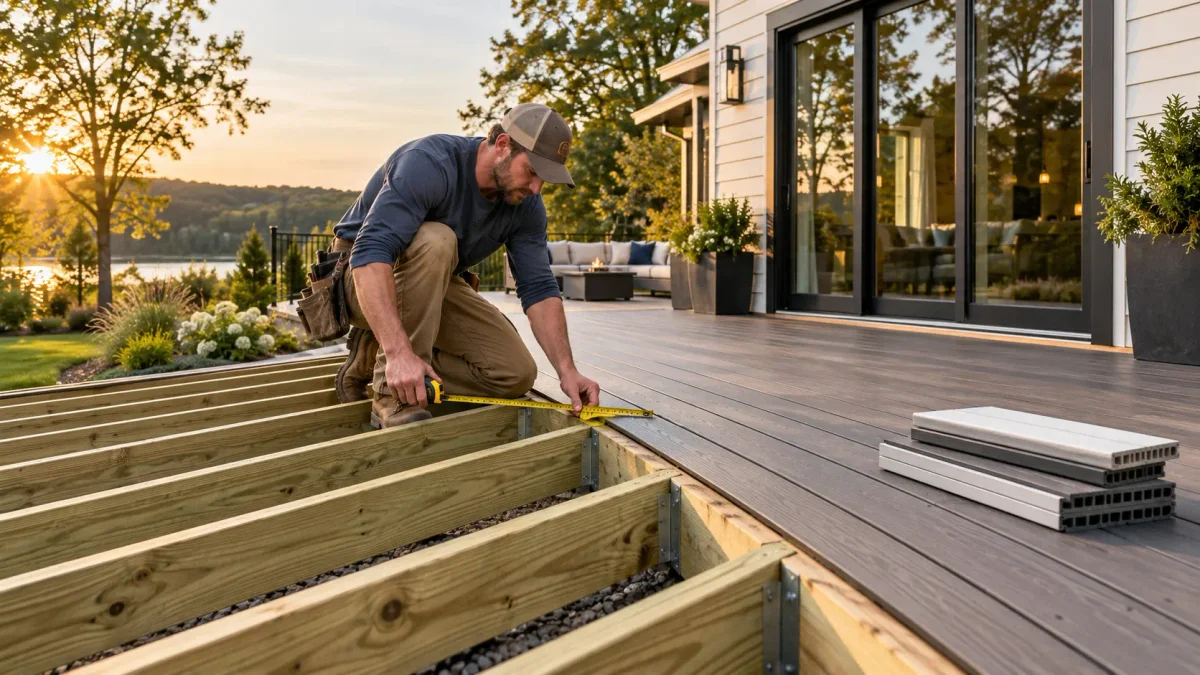
What a Deck Actually Costs Per Square Foot in 2026
Decking is one of the highest-return projects you can put on a house, but the cost spread by material is enormous — a pressure-treated deck and a capped-PVC deck of the same size can be $15,000 apart. The number that matters for planning is installed cost per square foot, which includes the substructure (footings, posts, beams, joists), the decking surface, fasteners, and labor. Here are the ranges contractors are quoting on standard residential decks as of mid-2026:
| Decking Material | Installed Cost/SF | 16x20 Deck (320 SF) | Maintenance / Lifespan |
|---|---|---|---|
| Pressure-treated pine | $20–$40 | $6,400–$12,800 | Seal every 2–3 yrs / 10–15 yrs |
| Cedar or redwood | $30–$50 | $9,600–$16,000 | Seal yearly / 15–20 yrs |
| Mid-grade composite (Trex Enhance, TimberTech Pro) | $35–$55 | $11,200–$17,600 | Wash only / 25–30 yrs |
| Premium composite (Trex Transcend, TimberTech Legacy) | $50–$70 | $16,000–$22,400 | Wash only / 30+ yrs |
| Capped cellular PVC (AZEK) | $55–$80 | $17,600–$25,600 | Wash only / 30–50 yrs |
| Tropical hardwood (ipe, cumaru) | $50–$80 | $16,000–$25,600 | Oil yearly / 40+ yrs |
A quick reality check: if a contractor quotes a 320 SF composite deck for under $10,000, look closely at the framing. The decking boards are only 40–60% of the job — the rest is the structure underneath, and that is exactly where a cheap bid cuts corners you cannot see once the boards go down.
Why Deck Prices Are Higher in 2026
Decking sits at the intersection of three materials that have all moved against homeowners this year: framing lumber, composite resins, and metal fasteners and railing.
Framing lumber and fasteners
The substructure of every deck — pressure-treated joists, beams, and posts — is framing lumber. After two years of relative calm, softwood framing lumber is up roughly 13% year-over-year heading into the 2026 building season, and the overall construction materials Producer Price Index reached a 6.0% year-over-year increase through March 2026 per Associated Builders and Contractors. Structural connectors, joist hangers, and the coated screws that hold a deck together are steel-based, and Section 232 tariffs holding steel and aluminum at 50% have pushed those small-but-essential line items up noticeably.
Composite and PVC boards
Composite and cellular-PVC decking are petroleum- and resin-based products. They have not spiked the way metals have, but manufacturers including Trex and TimberTech have taken multiple price increases since 2023 and none of it has come back down. Plan on 2026 composite pricing being flat to slightly up versus 2025 — not cheaper.
Labor
Labor is 40–60% of a finished deck. Skilled carpentry labor remains tight in most metros, and the elevation work, footings, and railing details on a deck are more labor-intensive per square foot than flat work like a slab. In high-cost coastal and Northeast markets, labor alone can run $25–$35/SF before a single board is bought.
Where Your Money Actually Goes
Understanding the cost breakdown is how you read a bid and spot the corner-cutting. Here is how a typical mid-grade composite deck divides up:
| Component | Share of Cost | What It Includes |
|---|---|---|
| Substructure / framing | 30–40% | Footings, posts, beams, PT joists, ledger, flashing |
| Decking boards | 25–35% | Surface boards, fascia, hidden fasteners |
| Railing | 15–25% | Posts, rails, balusters — $20–$200/LF installed |
| Labor (if not itemized above) | varies | Demo, layout, cutting, install, cleanup |
| Permits, stairs, extras | 5–15% | Permit fees, stairs, lighting, benches, skirting |
Two items quietly blow up deck budgets. The first is railing: composite railing runs $25–$60 per linear foot installed and aluminum or cable railing can hit $50–$200 per linear foot — on a deck with 60 feet of railing, that is a $1,500–$12,000 swing by itself. The second is footings: code typically requires a concrete footing or pier roughly every 64 SF plus corners, adding $2–$8/SF depending on frost depth and soil.
Composite vs. Pressure-Treated: The Lifetime Math
The sticker price pushes most homeowners toward pressure-treated wood, and for short-term ownership that is often the right call. But the honest comparison is total cost of ownership, and over the life of the home the math frequently flips. Here is the calculation I walk clients through for a 320 SF (16x20) deck:
| Metric | Pressure-Treated Pine | Mid-Grade Composite |
|---|---|---|
| Installed cost (2026) | $9,600 | $14,400 |
| Expected lifespan | 12–15 years | 25–30 years |
| Sealing / staining (25 yrs) | $3,000–$5,000 | $0 |
| Board replacement (25 yrs) | 1 full rebuild (~$12,000+) | None |
| 25-year total (est.) | $24,000–$26,000+ | $14,400–$16,000 |
Once you factor in re-staining every two to three years and a full deck rebuild somewhere around year 15, the “cheaper” pressure-treated deck often costs more over 25 years than composite — and that is before counting the weekends you spend sealing it. That said, if you are selling within five years, the payback never lands. Pressure-treated is the right financial call for short-term ownership. Match the material to how long you will own the house.
Deck Cost by Size in 2026
Per-square-foot pricing drops slightly as decks get larger because fixed costs like permits, mobilization, and stairs spread across more area. Here are typical all-in installed ranges by size:
| Deck Size | Pressure-Treated | Mid-Grade Composite | Capped PVC |
|---|---|---|---|
| 10x10 (100 SF) | $2,500–$4,500 | $3,800–$6,000 | $6,000–$8,500 |
| 12x16 (192 SF) | $4,200–$7,500 | $7,000–$10,500 | $10,500–$15,000 |
| 16x20 (320 SF) | $6,400–$12,800 | $11,200–$17,600 | $17,600–$25,600 |
| 20x20 (400 SF) | $8,000–$16,000 | $14,000–$22,000 | $22,000–$32,000 |
Elevated decks, second-story decks, and decks on sloped or rocky lots run higher because of taller posts, more footings, and required stairs. A ground-level platform deck is the cheapest configuration per square foot.
Regional Price Variation: Where You Live Changes the Number
Deck costs swing 30–50% by geography, driven mostly by labor rates, permit requirements, and frost depth — which dictates how deep your footings have to go.
Lower-cost markets (Southeast, Midwest)
Installed composite decks commonly run $35–$45/SF here. Milder winters mean shallower footings and a longer building season, and labor competition keeps carpentry rates moderate. A 320 SF composite deck often lands around $11,000–$14,000.
Higher-cost markets (Northeast, Pacific Northwest, California)
Expect $50–$70/SF installed for the same composite deck. Deeper frost footings (48 inches in much of the Northeast), shorter working seasons, and higher labor rates all add up. The same 320 SF deck can reach $18,000–$22,000, and that is before any premium railing.
What stays constant
Regardless of region, the substructure and railing are where bids diverge most. A contractor in a low-cost market can still deliver a bad deck with an underbuilt frame — geography sets the labor rate, but the spec is what protects you. Read the framing line items in every market.
What a Legitimate Deck Bid Should Include
A vague deck bid is where homeowners get hurt, because the expensive structural work is hidden under the pretty boards. Every line item below should appear on the estimate:
- Footing type, count, and depth (sonotube/concrete pier, dug below frost line)
- Post size and beam spec (e.g., 6x6 posts, doubled 2x10 beams)
- Joist size and spacing (2x8 or 2x10 at 16” O.C.; 12” O.C. for some composite)
- Ledger board attachment and flashing detail (lag bolts/structural screws, not nails)
- Joist tape on the framing tops (prevents rot, extends structure life)
- Decking brand, product line, and color — not just “composite”
- Hidden fastener system or face-screw pattern specified
- Railing material, height, and linear footage (code is 36” residential)
- Stairs: number of steps, stringer count, and railing
- Permit fees and who pulls the permit
- Cleanup, debris haul-off, and final grade
Red flags in a deck bid
- Lump-sum pricing with no framing spec — you cannot verify what is under the boards
- Nailed ledger or no flashing detail — the #1 cause of deck collapses
- “Composite” with no brand or product line named
- No footing depth listed in frost-prone regions
- Deposit over 30–40% before materials are on site
Get Your Deck Estimate in 60 Seconds
The ranges above are planning numbers, not bids. Pitch, height, railing length, stairs, and your local labor market all move the final figure. Here is the process I recommend:
- Run your numbers. Use our free deck calculator to enter dimensions, material, railing length, and state. You get an itemized estimate — framing, boards, fasteners, railing, and labor — with regional pricing built in.
- Get three written bids and use your calculated range as the benchmark. Any bid more than 25% above or below deserves a conversation.
- Compare scope, not bottom lines. The cheapest bid almost always has the thinnest framing spec.
Try the Free Deck Cost Calculator
Try Our Calculator →Get material quantities, labor projections, and a total budget range in under 60 seconds. Regional pricing for all 50 states. Full math shown. No signup required.
Frequently Asked Questions
How much does it cost to build a 12x16 deck in 2026?
A 12x16 deck (192 SF) runs about $4,200–$7,500 in pressure-treated wood, $7,000–$10,500 in mid-grade composite, and $10,500–$15,000 in capped PVC, installed. Railing length, stairs, and deck height move the number within those ranges.
Is composite decking worth the extra cost?
If you will own the home more than 10–15 years, yes. Composite costs 40–60% more upfront but eliminates staining and typically outlasts a pressure-treated deck by two to three times, so the 25-year total cost is usually lower. For ownership under five years, pressure-treated wood is the better financial call.
What is the cheapest decking material in 2026?
Pressure-treated pine at $20–$40 per square foot installed is the lowest-cost option and still the most common decking material in the U.S. The trade-off is ongoing maintenance and a shorter lifespan.
Do I need a permit to build a deck?
In most jurisdictions, yes — attached decks and decks over 30 inches above grade almost always require a permit and inspection. Budget $150–$500 in permit fees and never let a contractor talk you out of pulling one; unpermitted decks become a problem at resale.
How much can I save building the deck myself?
Since labor is 40–60% of the job, a capable DIY builder can cut a deck's cost roughly in half on materials-and-labor. But framing, ledger attachment, and footings are structural and life-safety work — if you are not confident in those, hire them out and DIY the finish details.
Data as of June 2026. Cost ranges based on BLS Producer Price Index data, ABC and NAHB construction cost reports, Zonda Cost vs. Value data, and national contractor pricing surveys. All estimates are for planning purposes. Actual costs vary by region, project complexity, and market conditions. Always obtain multiple bids from licensed contractors.
Related Articles
How Much Does It Cost to Pour a Concrete Driveway in 2026?
A concrete driveway costs $6.80-$11.90 per square foot for a plain slab in 2026. A PM breaks down thickness, rebar, base, removal, and bid red flags.
How the 2026 Energy Crisis Is Affecting U.S. Construction Material Prices
The Strait of Hormuz crisis is driving up diesel, steel, asphalt, and concrete costs across U.S. construction. Here's what the data shows and what to do now.

How to Read a Contractor's Estimate (And Catch What's Missing)
A construction PM explains every section of a contractor's estimate — line items, red flags, allowances, and how to compare bids before you sign.
Explore More Construction Calculators
Get an instant budget range for your next project — free, with the math shown.
Try the Deck Calculator